Monday, December 9, 2024

Book: Practice of Human Resource Management in Canada


Last week, I finally got a paper copy of a new textbook I co-authored, entitled the Practice of Human Resource Management in Canada. This is an open educational resource (OER) in that students can download and use the pdf version for free. If you want a paper copy, it is $39.99 (about $120 less than commercial texts). The book also offers a more nuanced view of HRM because it tackles how workers’ interests can shape effective HR practices

I first tried to write an intro HR textbook about seven years ago. Despite having a contract with a publisher and a draft written, that effort failed because my then co-author and I had an unresolvable disagreement. That was the second co-authored book project that failed that year (for different reasons) and I swore off writing books.

But then commercial publishers began getting greedy. The price of textbooks went up, including the price of e-texts. One publisher discontinued access an etext in the middle of a course (ack!). Another publisher began discontinuing etexts a year or so after new (generally unnecessary) versions of textbooks came out, forcing unnecessary course revisions.

So Jason Foster and I decided writing an OER was a good option, both in terms of managing our workloads and student costs. We’d previous written Health and Safety in Canadian Workplaces together, so I knew we could get a book across the line, even though an intro HR book would be about twice as long.

It took us about eight months to write the book. We then located a publisher, went through peer review, and found funding. And then the publisher ghosted us. After four months of non response (and we still have no real idea what happened), we started again with another publisher (i.e., back through the proposal and peer review stages).

After more than three years of work, I’m pretty happy to see this out in the world and adopted into Athabasca University’s HRMT 386: Introduction to Human Resource Management starting for February (?) enrollments. It is interesting to see AU’s renewed institutional interest in OERs (largely seeking to reduce institutional costs) coupled with very little incentive or support for faculty to author them.

-- Bob Barnetson

Monday, September 2, 2024

Book: Modern Whore: A Memoir

The public library came through last week with a copy of Modern Whore: A Memoir. This 2022 autobiography by Andrea Werhun recounts her career as an escort, exotic dancer, online performer, and a sex-worker advocate in Canada. 

Sex work often brings to mind images of outdoor work. Werhun’s stories offer insight into indoor sex work (which comprises most sex work). Werhun began as an escort working for an agency. Her stories explain, sometimes incidentally, how agencies work and the services they offer sex workers (e.g., screening, scheduling, payment, transportation, security), most of which run afoul of Canada’s present sex-work laws.

An interesting aspect is Werhun’s analysis of how online reviews, which are essential to getting work, give clients a mechanism by which to pressure sex worker to engage in behaviour they otherwise might decline. Werhun also helpfully posts a few of her reviews and then provides her own (presumably more accurate) recollections of those encounters to highlight the discrepancies.

After a break, Werhun returned to sex work as an exotic dancer. Again, she explains (often incidentally) how dancing works, what services the club provides, and the working conditions of dancers. Her stories help explain how these arrangements affect the workers, including what behaviours they permit and incentivize.

Finally, Werhun discusses how Covid-19 affected sex workers and her own efforts to shift to online work in the spring of 2020. This section is the least developed (since it was still ongoing at the time of publication) but highlights how individual circumstances and factors shaped the options available to sex workers during the initial stages of the pandemic.

Throughout the book, Werhun discusses in some depth how sex work (and the stigma surrounding it) affected her, including her relationships and her physical and mental health. She also presents an interest picture of the clients she saw, their motives for hiring sex workers, and their behaviours.

Overall, Modern Whore is well written and engaging andf would be of interest to students in LBST 415. It offers a useful look into contemporary indoor sex work in Canada as experienced by a well educated, white, cis woman from a middle-class background.

-- Bob Barnetson 

Tuesday, August 20, 2024

Last Night at the Strip Club

CBC Gem is airing a short documentary titled Last Night at the Strip Club. The auto-ethnography examines the impact the COVID-19 had on sex worker Andrea Werhun. Werhun was employed as an exotic dancer in the spring of 2020 and had to make some significant changes to her work due to COVID.

There are a couple of reasons to spend 12 minutes on this film. First, first-person discussions of sex work are rare enough that they're worthwhile to watch. They offer a useful counterpoint to more academic work. Stripping, in particular, is something of which I haven't seen a lot of first-person Canadian accounts. 

Second, Werhun is quite articulate about her experiences. The way she adapted to COVID shows a lot of savvy. The documentary predates her recent book Modern Whore: A Memoir, which I haven't yet read (and is apparently to be a film shortly).

-- Bob Barnetson

Monday, July 8, 2024

Athabasca University stalls bargaining right out of the gate

Bargaining between the Athabasca University Faculty Association (AUFA) and Athabasca University (AU) kicked off June 28th with an exchange of proposals. You can read the details here but the short version is: 
  1. AU refused to table its monetary proposal, and 
  2. AU has refused to set further bargaining dates unless AUFA agrees to meet in person (instead of bargaining via video conference). 
Since I'm no longer president of the union, I don't have to be polite about this approach to bargaining, which is stupid for many reasons, including:
  • Practical: A union can’t get an agreement (which is the goal of bargaining) when the employer refuses to say what it wants and refuses to meet. Being unreasonable serves no one’s interests, including the employer’s.
  • Strategic: While AU might have gotten away with stalling on a full proposal for a while, refusing to bargain until AUFA agrees to bargain exactly how the employer wants to bargain is contrary to the Labour Relations Code. There are good reasons to bargain online (e.g., significant travel costs, child-care issues, health issues) and AU has provided no coherent or compelling reason to refuse to bargain by unless it is face-to-face. The employer will eventually have to abandon this demand and, when it does, it will look (even more) incompetent and unreasonable than it does now.
  • Political: AU ran this same play last round and it resulted in a near strike. A repeat of this approach has dramatically raised tensions among the members for no real gain. Most AUFA members are now angry and frustrated and AU’s bargaining team just spent all of the new president’s political capital for no real gain (“meet the new boss, same as the old boss”). In less than 20 minutes, AU also drove AUFA’s bargaining team (who are mostly new) from “let’s bargain in good faith and try to get a deal” to “fuck these clowns.” For a union, there is simply no better organizing force in the world than a terrible employer.
It is hard to fathom why AU insists on meeting in person. My best guess is this is some kind of dick-measuring contest, where the employer wants to show the union that it sets the terms of bargaining.

Alternately, it could be that the employer is stalling because it is not prepared to bargain. The union hasn’t shared AU’s non-monetary proposal yet (I imagine that is coming in the next few weeks) but it is basically a rehash of stuff from the 2020-2022 round of bargaining, which provides some support for the “not ready” hypothesis.

If there is a strategy behind refusing to provide a monetary offer, I’m hard pressed to see it. The government has issued a mandate across the public sector for a four-year deal with a cost-of-living adjustment of 2%, 2%, 1.75%, and 1.75%. AU will either open with that or with something even worse (like the U of Lethbridge has). Either way, withholding the monetary just makes AU look like uncooperative dicks and AU gains nothing from the eventual reveal.

Maybe the strategy is to try and lure AUFA into settling the non-monetary stuff first (thereby giving up the opportunity to trade language for a monetary offer the employer could live with)? Since AUFA isn’t stupid, it is obviously not going to fall into that trap so delaying providing a monetary proposal is just wasting everyone’s time.

Overall, alienating the union and its members (to no real gain) is a bad way for Athabasca University to start to bargaining and raises real questions about the competence of whomever is directing AU's bargaining approach. At this point, the employer’s best pathway to a deal that doesn’t involve a work stoppage is to set dates and provide a full offer, maybe with a mea culpa to smooth things over.

Since AU is showing zero labour-relations game, I imagine we’re off to the Labour Board. In the meantime, the union will begin the process of dissecting the employer’s proposal and building resistance to it among the members as part of its strike preparations.

I’d hoped that AU changing its spokesperson signalled a desire for better labour relations. Apparently not. If I had to guess how this will play out, I'd say there will be no real progress at the table, AUFA will declare impasse in the fall, and we go to mediation where the employer will be forced to actually start bargaining. 

This is super disrespectful of the employer and heightens the risk of an  unnecessary "fuck you" strike. Glad I kept my picket sign from last time. If anyone wants in on the pool about which employer-side rep gets throw under the bus first by AU when this goes off the rails, shoot me an email.

-- Bob Barnetson

Friday, February 23, 2024

Research: Government interference in collective bargaining

Earlier this week, the Parkland Institute released a report that I contributed to, entitled Thumb on the scale: Alberta government interference in public-sector bargaining.

This report examines how, in a time when workers’ Charter-protected associational rights appear to be expanding, the rate at which governments interfere with collective bargaining has skyrocketed.

It specifically looks at Alberta’s ongoing use of secret bargaining mandates, which turn public-sector bargaining into a hollow and fettered process.

This report is relevant because both UNA and AUPE have exchanged opening proposals with the government in the last few weeks and will be bargaining against secret mandates. The government opener in both cases was, unsurprisingly, identical and there is a huge gap between what workers are asking for and what the government is offering.

-- Bob Barnetson

Friday, January 12, 2024

New research on unions' impact on wages and benefits

In November, Andrew Stevens and Angele Poirier released a report that examined the union effect on wages and benefits across Canada to 2022, with the data for Saskatchewan also broken out.

Nationally, unionized workers earned an average of 11% more than non-unionized workers. There was significant provincial, gender, age, and sectoral variation. The union advantage appeared particularly pronounced for workers aged 15 to 24 (+26%) and part-time workers (+41%).

Unionized workers were also more likely to have paid sick time (80% versus 555 for nonunionized). Unionized workers were also much more likely to have employment-related pension plans (825 versus 37%) as well as other supplementary benefits.

Interestingly, non-unionized workers experienced slightly higher wage increases between 2020 and 2022. This might reflect pressure on non-union employers to improve wages in order to attract and retain staff (i.e., is a union spill-over effect). It might also reflect that union contracts (which fix compensation for a period of time) may delay increases (e.g., inflationary bumps) or unionized workers (who are very often in the public sector) may have been subject to mandated wage freezes and rollbacks by the state.

-- Bob Barnetson

Thursday, December 14, 2023

Disaster responses, OHS and COVID

One of many tasks of OHS practitioners is to plan organizational responses to disasters. The most common kind of workplace disaster we develop plans for are building fires. In fact, the laws passed in the wake of the Triangle Shirtwaist Fire are some of the earliest forms of OHS regulation.

In planning a response to a fire (hint: get out), it can be useful to know how people respond to rapidly evolving, high-stress, low-frequency events and why they respond that way. Last week, I ran across a 2004 article entitled “Why people freeze in an emergency: Temporal and cognitive constrains on survival responses

Basically, the author looked at the literature, examined disaster inquiry reports, and interviewed a bunch of disaster survivors to verify the existence of freezing behaviour in disasters and quantify it. He concluded:

Responses to unfolding disaster can be divided broadly into three groups.

In the first group, between 10‐15% of people will remain relatively calm. They will be able to collect their thoughts quickly, their awareness of the situation will be intact, and their judgment and reasoning abilities will remain relatively unimpaired. They will be able to assess the situation, make a plan, and act on it.

The second group, comprising approximately 75% of the population, will be stunned and bewildered, showing impaired reasoning and sluggish thinking. They will behave in a reflexive, almost automatic manner.

The third group, comprising 10‐15% of the population, will tend to show a high degree of counterproductive behavior adding to their danger, such as uncontrolled weeping, confusion, screaming, and paralyzing anxiety (Leach, 2004).

This finding is important because, generally speaking, the mechanisms we create to allow people to protect or save themselves in such situations requires them to take immediate and sensible action (e.g., use fire exits, put in a life vest, open an emergency exit on a plane). If only 10-15% of people can be relied upon to do so, then these mechanisms likely won’t achieve their desired result (i.e., nobody dies).

The author attempts to explain maladaptive emergency behaviour by conjecturing that sub-optimal responses are related to our brains’ information-processing limitations. He asserts that, when faced with a novel event, our brain requires time to assess it, develop a plan, and execute it.

Disasters, which are novel and complex and involve significant stress, often unfold too quickly for us to meaningfully react. However, he says, since your brain can select among a pre-existing behaviours much faster than it can design new behaviours, training on how to respond can attenuate this effect. (This is why we do fire drills and why you get a safety briefing before every time a plane takes off.)

The explanation advanced by this article has intuitive appeal (i.e., it sounds plausible on first blush), but the question is whether the explanation is correct. Recall that the conclusion (i.e., brain too slow) is conjecture, rather than the results of any empirical testing. I spent some time looking for evidence that this conjecture was correct and didn’t find much (although this isn’t my field and maybe I looked in the wrong places; I also ran into a bunch of paywalls that I could not get past).

What I found was:
So maybe there is something to the original author’s explanation for this well documented phenomenon but YMMV. An important barrier to proving it is simulating the necessary degree of stress in an experiment.

The reason this article came up in my feed (I think on Bluesky but maybe Twitter) is that someone was likening the three-group typology to explain people’s reactions to Covid. Basically the asserted that the calm, muddled, and counterproductive groups in the 2004 disaster study are analogous to active avoiders, passive avoiders, and minimizers.

This analogy was intuitively appealing, bolstered by the seeming authority of the original study. It is useful, though, to deliberate a bit about whether the disasters that the original article looked at (e.g., a ferry sinking or a plane catching fire) is similar enough to Covid for conjectured explanation to apply. A key difference that jumps almost immediately to mind is the time scale.

Contemporary Covid behaviours are the result of a lengthy process. While Covid is a novel event, the time-scale is not the same as the disasters that the original author explored (where the speed of the disaster may have outpaced decision making).

So, while the proportion of active avoiders, passive avoiders, and minimizers may (or may not) mirror the groupings in the disaster study, the similarities between disasters and Covid are likely superficial and coincidental. Thus, we ought not put much stock in the claim that the 2004 study is in any was applicable or instructive to understanding Covid responses.

-- Bob Barnetson

Monday, November 20, 2023

Bill 5 continues government interference in collective bargaining


Canada has a long tradition of governments using their power as legislators to give themselves a further advantage in their role as an employer. This is called permanent exceptionalism. Basically, governments pass laws undermining public-sector workers’ bargaining power, justifying them as temporary and exceptional interventions, except they are neither.

My colleagues Jason Foster and Susan Cake and I published a study of legislative interventions in labour relations from 2000 to 2020 in a recent issue of the Canadian Labour & Employment Law Journal (vol 25, issue 1) called “Catch me if you can”: Changing forms of permanent exceptionalism in response to Charter jurisprudence.”

The upshot is that, during a time when the Supreme Court was finding that workers’ associational rights in the Charter included the right to collectively bargain and strike free from substantial interference, the rate of government interference significantly increased (tripling over the 1990s). Basically, governments have become addicted to rigging the game against public-sector workers.

Back in 2019, Alberta’s UCP government passed the Public Sector Employers Act. The PSEA allowed the government to give public-sector employers secret and binding bargaining mandates. This made the 2020 round of public-sector bargaining a hollow and fettered process (our study about this is currently in review) and let the government drive home a combination of wage freezes, miserly wage increases, and other rollbacks. This built upon a similar strategy use by the NDP government in the 2017 round of bargaining that also delivered several years of wage freezes.

Presently, the legislature is debating Bill 5, which amends the PSEA. The headlines around this Act have focused on how the government will be better able to attract certain types of public-sector workers (i.e., wages are too low) while also now controlling the wages for non-unionized workers via secret bargaining directives. In the house, the NDP is flagging how Bill 5 opens the door to pork-barrelling for public-sector CEOs.

Almost no one is examining how Bill 5 extends the original secret mandate powers. The new bill allows the government to create employer committees and associations to coordinate (and perhaps perform) bargaining, potentially on sector-wide bases. This is pretty much how it works at the big tables in education, health-care, and the core civil service now.

But, for the 250-odd bargaining tables among agencies, boards, and commissions, these amendments would allow for big changes. In theory, employers could bargain cooperatively against dozens and dozens of disparate small unions and union locals, each bargaining on their own. Combined with an inflexible government mandate, this would make it very hard for these workers to get a decent deal and would make it much easier for the government (via these employers) to drive further concessions into these contracts. There are no similar provisions for sectoral bargaining arrangements for workers.

Alberta is already suffering from significant staffing shortages in health-care and education. Further grinding wages and hollowing out of public sector-bargaining (combined with the government threatening to take control of Albertan’s Canada Pension Plan contributions and its efforts to grab up public-sector pensions) will make Alberta an unattractive place for new graduates to stay.

-- Bob Barnetson

Wednesday, October 18, 2023

Alberta Labour 2023 Annual Report

Alberta has released its 2023 annual report for the part of the government that was at one time called Labour and that relate to Albertans being safe and treated fairly in the workplace.

Fairness at Work Declines

The number of employment standards complaints filed were up by about a third in 2022/23. Complaints tend to reflect a fraction of overall violations; most workers don’t bother reporting things like wage theft.


This is an interesting reversal of a long-term decline in employment standards complaints.


Notably, the time to begin an investigation tripled and the time to resolve a complaint doubled. This has long been a bugbear in the employment standards system. The report asserts this reflects increasing volume and complexity.

The number of complaints investigated with signs of human trafficking jumped from 102 in 2021/22 to 208 in 20223/23.

The number of administrative penalties issued to employers dropped from 3 in 2021/22 to zero in 2022/23.

Safety: Losing the Will to Enforce

Worksite inspections plus re-inspections totalled 13,717 in 2023/23, down 12% from 15,569 in 2021/22. If you look later in the report for some context, this is about 6% fewer inspections/re-inspections than in 2018/19 (14,590), which was the last full year when the NDs were in power. At this rate, the inspection cycle is theoretically about once every 15 years (give or take).


About 80% of inspections were the results of complaints while the remaining 20% were targeting industries with safety problems. There were 1207 proactive inspections in 2022/23 resulting in 1725 orders issued. This is down from 2021/22, with 2100 inspections and 2548 orders. I couldn't find any historical data in this to provide context.

The number of investigations (e.g., of injuries) dropped by 60%, from 2245 in 2018/19 to 888 in 2022/23.

Orders written were up slightly over 2021/22 to 9099. This may be good (more enforcement) or may be bad (more violations occuring)—hard to say. If you look at 2018/19, there were 16,680 orders issued.

Ticketing of violators was down. There were 27 tickets with a total value of $11,280 issued in 2022/23. This is slightly fewer than in 2021/22 (32 tickets, $11,500). This reporting leaves out important context. If you look at 2018/19, there were 479 tickets issued.

Administrative penalties were also down. There were 17 penalties worth $62,025 issued in 2022/23. This is notably fewer than in 2021/22 (37, $314,250).

Convictions were also down, with 2022/23 seeing $1,740,750 in fines assessed. This is down from $1,919,000 in 2021/22. There was no reporting of the number of convictions but a hand count suggests the number is stable the last few years at around (hand-waggle) 10 per year, down from more than 20 in 2018/19.

Injury Rates are Up: Yeah, it’s mostly COVID.

The lost-time claim rate rose for at least the seventh straight year. Much, but not all, of this increase is due to COVID-19 injuries.


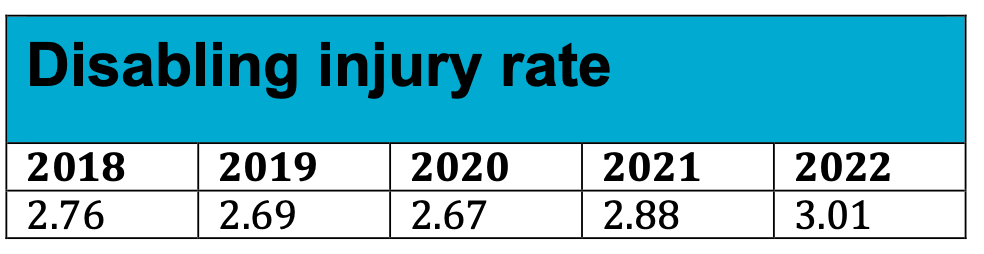
The disabling injury rate (lost-time plus modified work) is also up. Again, much but not all of the increase is due to COVID injuries.


The absence of meaningful government protocols related to aerosol spread put responsibility for these COVID-related increases squarely on the shoulders of government.

Interestingly, the absolute number of accepted fatalities is down to 120 (from 136). There is no real analysis of that change. It could be the result of changes in the workforce composition. It could also just be random variation (small numbers tends to be swingy).

Analysis

Overall, it looks like the government continues to lose the will and/or capacity to meaningfully enforce workplace safety rules under the UCP. Not surprisingly, the rate of injury has risen, likely because workplaces are more dangerous.

There has also been an uptick in complaints about employment standards (basically wage theft). This could be caused by more workers knowing to and being willing to come forward. I’d guess, though, that this reflects employers knowing it is open-season on workers under the UCP and, thus, stealing wages more frequently.

-- Bob Barnetson


Tuesday, October 17, 2023

John Oliver on Union Busting

A friend sent me this clip of John Oliver exploring union busting in the United States.

Very applicable to Canada as well.

-- Bob Barnetson

Tuesday, October 3, 2023

Climate change and safety: treeplanters and wildfire smoke

A few weeks back, the Tyee ran a story on the effect of increasing levels of wildfire smoke on tree planter OHS. This story is interesting because it looks at the effect of climate change on worker safety.

There are several reasons why this particular hazard and worker group are worth examining:
  • Intensity of exposure: Tree planters often work in close proximity to wildfires and their work is physically demanding (increasing respiration and heart rate). Consequently, they are likely to have one of the highest intensities of exposure to wildfire smoke.
  • Duration of exposure: In addition to long working days, most tree planters live in camps (e.g., tents) and lack any respite from the smoke in their off hours. This means these workers have a much longer duration of exposure than, say, a worker who might face dust in the workplace but then go home to clean air at the end of the day.
  • Lack of specific controls or OELs: There are no specific occupational exposure limits (OELs) for wildfire smoke and general OELs for dust were not designed with wildfire smoke (which has very tiny particles) in mind.
  • Latency: Injuries due to inhalation often have long latency periods and murky causality, thus the link between the work exposure and the ill-health can be hard to see.
  • Proxy for nonworkers: The exposures experienced by tree planters can be useful in predicting larger population effects caused by increased wildfire effects (essentially the dangerous working conditions experienced by these workers create a natural experiment).
  • Compliance: PPE slows tree planting work. Tree planters are generally paid on piece-rate basis. This pay structure basically forces tree planters to trade off their own health against their need to earn an adequate income and almost certainly reduces compliance. Contractors also have production targets, which means they too have an incentive to trade worker safety for profit.
A notable take-away from the article is the complete lack of a regulatory response to the risk posed by wildfire smoke. WorkSafeBC acknowledges the risk but can’t be arsed to issue any directives. Alberta’s OHS minister couldn’t even be bothered to respond to the reporter. This likely reflects regulatory capture of regulators by the forestry industry.

By contrast, Oregon and California require air quality monitoring and the availability of respirators when air quality gets to a specific point. This doesn’t mean these controls are adequate, but they are at least something.

-- Bob Barnetson

Wednesday, September 13, 2023

Another worker dies, nothing much happens.

Yesterday, CBC reported that three companies had been charged in a November 2021 workplace death. The worker was testing a pipe when a valve broke and killed the worker. Among the notable parts of the story is that the employer failed to conduct a hazard assessment and failed to identify a hazard.

The effectiveness of the OHS system rests on employers identifying hazards. When an employer fails to do this rudimentary task, the rest of the system doesn’t work because unidentified hazards can’t be controlled and workers die as a result.\

Unfortunately, Alberta employers often don’t bother to identify hazards. A 2018 survey of 2000 Alberta workers found only 50% of their employers had hazard assessments. And only 59% regularly provided information about hazard-control strategies for at least some of the hazards workers faced.

So, now that OHS has filed charges almost two years after the event, what is likely to happen in this case? The rest of the CBC article talks about other fatalities and gives you a pretty good idea.

The employers’ lawyer(s) will likely stall some. A year or two from now, one of the employers will plead guilty to a single charge and pay a relatively small fine ($100-300k). In the meantime, it will be business as usual.

If you think this sounds like a pretty ineffective approach to protecting workers, you’d be right. The same study found that roughly 1 in 5 Alberta workers reported injuries (of varying degrees) each year and 1 in 11 received a disabling injury (where they could not do some or all of their job the next day).

Underlying ineffective enforcement is basically a lack of political will to punish employers to maiming and killing workers. Indeed, the UCP substantially weakened OHS laws during its first term. Not surprisingly, the rate of worker injury has risen under the UCP’s watch.

-- Bob Barnetson

Wednesday, September 6, 2023

Six Worries for Workers This Labour Day

This blog was originally posted on the Parkland Institute blog.

What can Alberta workers expect from a United Conservative Party government over the next four years? The UCP’s first term cheapened labour costs for employers. Its 2023 election platform contained few promises related to labour and employment issues beyond the usual nostrums about low taxes creating jobs. We think workers should watch six issues.

1. Low wages, high unemployment, and Inequity

While the number of jobs in Alberta has increased, more job seekers and layoffs mean Alberta’s unemployment rate remains the fifth highest in Canada. For those with jobs, the purchasing power of their average hourly wage has fallen by 4.95% (or about $3,000 per worker) over the past 10 years. Alberta is only one of three provinces to experience this loss.

By October, Alberta’s minimum wage will be the third lowest in the country while Alberta’s cost of living remains among the highest. The UCP is unlikely to raise the minimum wage from 2018’s $15 per hour. This means inflation will further erode the purchasing power of 11.5% of Alberta workers, the majority of whom are women.

Not surprisingly, Alberta also continues to have the highest gender wage gap in Canada. In July of 2023, Alberta women earned 84 cents for every dollar men earned (averaging $31.52 per hour vs. $37.61 per hour). The UCP is unlikely to address this gap.

2. Illusion of low-cost childcare

Under an agreement with the federal government, the UCP has promised to implement $10 per day childcare by 2026 as well as create 70,000 additional spaces. While childcare fees have declined, $10 per day childcare is likely to be a chimera.

In February, the UCP established a cost-control framework for childcare. Government funding will ensure that “core” childcare is provided for $10 per day. But the UCP is encouraging providers to charge fees for “enhanced” childcare, such as food, activities, playground equipment, and better qualified staff. Providers are being told they do not have to spend all of these enhanced fees on the enhanced services (i.e., private providers can pad their profits with these fees).

Since demand for childcare spaces will continue to outstrip supply, parents who decline to pay the enhanced fees (i.e., want $10 per day childcare) may have difficulty securing a space because they reduce the providers’ profits. Further, low wages and limited training and professional development opportunities suggest the goal of 70,000 additional spaces may be wildly optimistic.

3. An Alberta Pension Plan

Alberta has been flirting with the idea of leaving the Canada Pension Plan (CPP) and creating an Alberta Pension Plan (APP) since 2019, putatively to lower premiums. The UCP did not campaign on the APP, likely because more than half of Albertans are opposed to the idea.

Withdrawing from the CPP requires three years of notice. The terms of Alberta’s departure are difficult to predict since no jurisdiction has ever left the plan. Departure may constitute a major change in the plan, which would require the approval of 7 of the 10 provinces (representing two-thirds of the population) and the federal government.

There are many unanswered questions about an APP, including its financial stability and likely returns, operating cost, the portability of contributions, and its susceptibility to political meddling. Quebec’s experience with running its own pension plan suggests that doing so does not necessarily result in lower premiums.

4. Public-sector bargaining

In 2019, the UCP gave itself the power to foist secret bargaining mandates on public-sector employers, rendering collective bargaining a fettered and hollow process. All unions eventually settled for wage increases well below inflation, after years of prior wage freezes. Despite the negative impact that uncompetitive wages have on recruitment, retention, and productivity, it is likely the UCP will go back to this well in the hope of further grinding public-sector wages.

It is unclear whether Alberta’s public-sector workers and their unions have the will to meaningfully resist such a tactic. Resistance would require workers to strike and, perhaps, to do so illegally in the face of back-to-work legislation. That is a risky proposition for both workers and their unions’ leadership. That said, only last fall, Ontario’s unions forced the Ford government to walk back legislated contracts through an illegal strike by education workers that looked set to escalate to a general strike.

Public-sector workers are also likely to see further privatization of their jobs, as the UCP did with laundry and laboratory services in health care. The UCP may also provide more public funding to private-sector providers of education and health-care services.

5. Recruitment and Retention

Not surprisingly, declining compensation, childcare shortages, and uncertainty about the CPP have meant some Alberta employers are struggling to recruit and retain workers. The UCP has promised a $1,200 tax credit for workers in fields such as health care, childcare, and the skilled trades who come and work in Alberta for at least a year, and a $3,000 to $10,000 tax credit (spread over multiple years) for new graduates in unspecified fields who stay in Alberta to work.

These promises are essentially an admission that Alberta is not an attractive place to live and work. Neither promise is very significant in monetary terms and, if implemented, they are unlikely to have much impact on worker shortages because of the negative impact of the UCP’s education and health-care agenda. Increasing post-secondary tuition and a defective K-12 curriculum (e.g., “find gravity on a globe”) make Alberta an unattractive place to study or raise children. Ongoing staffing shortages, the unavailability of rural obstetrical care, and the botched privatization of laboratory services suggest the health-care system is also failing.

6. Union Dues and Bill 32

The UCP has promised to fix one of their controversial changes to Alberta’s labour laws (commonly called Bill 32) that accidentally cost community organizations $2.5 million in lost donations from unions. This happened because Bill 32 required unions to get each member to authorize dues deductions for activities beyond collective bargaining and contract administration. This was designed to constrain unions’ abilities to participate in political and advocacy campaigns but also affected donations.

Before the election, many unions quietly decided to simply ignore Bill 32. It will be interesting to watch how (and, indeed, if) the UCP handles enforcement. It may choose to pursue legal action against these unions. Or it may take the position Bill 32 achieved its political goals and ignore widespread non-compliance.

Conclusion

The UCP has a difficult course to navigate over the next four years. Its political goals include low taxes, low wages, a diminished public sector, and increased privatization. None of the outcomes of these goals are attractive to the skilled workers that Alberta requires. Indeed, declining real-dollar wages, failing health-care and education systems, unstable retirement income, and unavailable childcare are likely to impede both worker recruitment and retention.

-- Bob Barnetson, Susan Cake, and Jason Foster

Monday, July 24, 2023

Hollywood strikes highlight undercurrent of violence in labour relations

Two strikes, one affecting writers and the other actors, have brought most Hollywood productions to a stand-still over the past two months. 

You can read a summary here but the gist is major studios are trying to cheapen work in order to gain a greater portion of the surplus value generated by labour.

The bosses’ strategy, at least with respect to the Writers Guild of America, appears to be simply starving out the workers. According to Vanity Fair, the bosses expect writers to run out of money by October and, once the workers are facing homelessness, they will resume negotiations and press for concessions. Starving workers until they give up is an age-old employer tactic.

Actor Ron Perlman, in a now deleted video, reacted to the bosses’ plan this way:
The motherfucker who said we’re gonna keep this thing going until people start losing their houses and apartments — listen to me motherfucker. 
There’s a lot of ways to lose your house. Some of it is financial. Some of it is karma. And some of it is just figuring out who the fuck said that — and we know who said that — and where he fucking lives.

There’s a lot of ways to lose your house. You wish that on people? You wish that families starve while you’re making 27 fucking million dollars a year for creating nothing? Be careful motherfucker. Be really careful. Because that’s the kinda shit that stirs shit up.
Perlman’s statement got quite a lot of media play because it is out of step with most people’s understanding of how contemporary strikes play out (basically people stop working and walk around with signs until the boss decides to negotiate). Suggesting that bosses might face violent, real-world consequences for trying to get even richer by economically destroying workers’ lives is pretty uncommon these days.

That hasn't always been true, though. Underlying every job action is the potential for violence. Often it has been used by bosses to bust a strike. But, occasionally, workers will destroy the bosses’ property or attack them directly. The post-war labour compromise in Canada has attenuated this risk, in part by strictly regulating strikes and strike behaviour.

But, when the bosses refuse to negotiate in good faith (or the system looks otherwise completely rigged against them), worker commitment to obeying labour law may fray because it is no longer in their interest to do so.

We most often see this dynamic play out in wildcat strikes. But worker frustration doesn’t have to be channelled in that direction. A worker or smnall group of workers could, as Perlman hints, just destroy a boss’s house or yacht or factory or mine or whatever.

It is worthwhile for both bosses and workers to pay attention to the potential for this kind of behaviour as they strategize how to bargain. Bosses who decide to play hardball, may be opening Pandora’s box. And worker may be overlooking a significant source of leverage by discounting alternatives to picketing.

-- Bob Barnetson

Friday, June 30, 2023

Update: AUFA members to vote on reversing exec decision

Two weeks ago, I wrote about the Athabasca University Faculty Association (AUFA) executive deciding to make a cash donation to a member. Yesterday, the AUFA membership forced a special meeting on the issue and will soon be voting of a motion to reverse this decision.

A good outcome of the meeting was support for the development of a formal member emergency fund. There are lots of examples to choose from. Most have these features:
  • a low- or no-interest loan for a fixed period of time,
  • available to members on application,
  • a requirement for some disclosure of the circumstances giving rise to the need, and
  • decisions being made by a committee without a real or perceived conflict of interest.
The meeting itself flushed out some additional information about the executive’s donation. While I am hopeful that a recording of the meeting will be available to all AUFA members prior to the vote, I worry that the disclosure of the member’s identity by a member of the incoming executive during the meeting may preclude the union from sharing the recording. So, for those who could not attend, here is a recap (I have flagged the new info below):
  1. In early June, the executive held an emergency meeting three days before a regularly scheduled executive meeting.
  2. The purpose of the emergency meeting was to vote on a donation to a member whose salary had been cut off for refusing to comply with an employer direction (i.e., the member choose this outcome).
  3. NEW The member did not ask for this money. Rather, this motion was an initiative of a member of the executive.
  4. The executive was not told before voting on the donation that the member could have their salary restored simply by complying with the employer’s demand.
  5. NEW The donation was to another member of the executive.
  6. The recipient was not named in the notion meaning the payment could not be implemented.
  7. Multiple members of the executive resigned over the decision.
  8. The executive did not communicate this unprecedented move to the membership until nearly a week later and under pressure that I would tell the members if they did not. 
  9. The eventual disclosure (which occurred after voting for the next union executive had concluded) left out important information about the donation, including the resignations that had resulted from it.
So, is this decision by the executive one that should be reversed by the members?

One way to answer that is to look at how far the executive’s process deviated from the typical approach to emergency funds that I set out above.
  • There was a donation in lieu of a no-interest loan. There is no explanation for this.
  • The member never asked for the money; this was an initiative of an executive member. This raises the question of whether the member is even in need of the money? 
  • Key facts were not disclosed to the decision makers. Specifically, (1) evidence of hardship, and (2) that the member was refusing to take action that would restore the member’s salary (which is a bit like drowning in a bathtub because you refuse to sit up).
  • The recipient was a member of the same committee that made the decision. This may not create a conflict of interest (that is very hard to tell given the information the executive has provided) but it creates the appearance of a conflict of interest.
Overall, this was a bad process that led to what looks like a bad decision that was then communicated in way that was untimely and incomplete. Consequently, I think this decision, at the very least, warrants a do-over using a better process. The way to achieve that is for the members to pass a motion reversing the decision. The executive could, of course, rescind their decision and do a proper job of it once they have a fund set up.

It is notable that the executive has not followed through on the other motion it passed during the emergency meeting: strike a committee to establish a member emergency fund. Had they done that, members could be voting on that right now (there are lots of examples to cut and paste from, including AUFA’s emergency fund from its strike prep). This inaction is notable because the executive are, on the one hand, aggressively defending their decision but, on the other hand, taking no actual steps that would get their decision implemented (and get the member the money).

Several other motions planned for the meeting (including a non-confidence vote in the lame-duck executive) did not get discussed. An important issue going forward is that AUFA members (who almost all work from home) have no effective mechanism to discuss matters of concern as a group. Hopefully next year’s executive will do something about that.

-- Bob Barnetson

Friday, June 16, 2023

AUFA executive resignations follow unusual payment to member

Last Friday, the executive of the Athabasca University Faculty Association (AUFA) held an emergency meeting. After an apparently acrimonious discussion, the executive voted 5-4 to “donate” $2500 to another member. Subsequently, five members of the executive resigned and the treasurer is unable to make the payment because of the wording of the motion. 

The remaining members of the AUFA executive finally released some information about this payment a week later, after I threatened to go directly to the members. But the executive have left out important context and the subsequent resignations. These omissions are very troubling. This information also comes only after the union’s elections have concluded.

This post compiles the information I have been able to verify about these very concerning events. I believe this decision shows very poor judgment and that the remaining members of the executive who voted in favour of this motion should resign. I understand that one of them has done so this morning.

Background

I’ve redacted some of the details but the gist is that a member declined to comply with an employer direction (i.e., was insubordinate). After several unsuccessful attempts to gain compliance, the employer placed the member on an unpaid leave.

As much as I don’t generally like how AU behaves, placing a member on unpaid leave is permissible in these very specific circumstances (that I am carefully not discussing). This has happened periodically over the past 15 years that I’ve been active with the association and is not an unprecedented situation (what is unprecedented is the payment).

The member decided to continue not complying (and thus not be paid). While being placed on an unpaid leave can certainly create a financial emergency for a member, this is not a labour-relations emergency for the union.

Subsequently, a member of the executive sought an emergency executive meeting to authorize payment of $2500 in financial aid. AUFA does not presently have a system for providing financial aid to members. The union did create an emergency-loan system in anticipation of a strike last year. Absent a work stoppage, that system does not operate because the members have not approved expanding its parameters.

Consequently, this request was brought to the union executive as an ad hoc motion. Article 12.8 of the AUFA bylaws permits the executive to authorize unbudgeted payments of up to $5000 without seeking membership approval.

Nine (of then 13) voting members of the executive were able to attend the emergency meeting:
  • Davina Bhandar 
  • Pamela Holway
  • Jonathan Leggo,
  • Gail Leicht
  • Katie MacDonald
  • Darka Pavlovic
  • Kristin Rodier
  • Rhiannon Rutherford
  • Ching Tan
After an in camera discussion, MacDonald and Bhandar moved:

“AUFA make a one-time donation of $2500 to the member in question in support of undue hardship.”

This motion passed 5-4 with Leggo, Leicht, Pavlovic, and Rutherford opposed. A subsequent motion established an ad hoc committee to look into establishing a formal member emergency fund (which is a good idea).

While no one has been prepared to discuss all of the details of the in camera discussion, some attendees have characterized the information provided to them an incomplete. For example, they were not told that the member could have their pay restored by simply complying with the employer’s direction.

Over the next several days, Leggo and Pavlovic along with Florene Ypma and Dave Powell resigned from the executive over the motion. Leicht (who is also the treasurer) has also indicated she will be resigning as soon as the executive can put someone in place to perform financial oversight functions. In the meantime, she has declined to issue the cheque because she does not have a name and mailing address to permit the issuance of a cheque.

Questions

A number of questions jump to mind:
  1. Why it was necessary to call an emergency meeting last Friday when there was regularly scheduled meeting three working days later? An emergency meeting likely reduced the number of executive members able to attend.
  2. Why the secrecy within the executive about who the member is? How can the executive make an informed and accountable decision without recording to whom the payment was made (even if this information is shared only on a need-to-know basis)?
  3. Why was the executive not informed during the discussion that the member who received the payment could have their pay restored by ceasing their insubordination?
  4. Why was the funding provided as a donation, rather than as an interest-free loan?
  5. Has this decision established a precedent whereby other members who refuse to comply with legitimate employer directions (i.e., are insubordinate) can now seek financial support from the union?
  6. Why did the remaining executive not inform the AUFA membership of this significant departure from past practice and the subsequent resignation of five executive members in a timely manner? This question is especially salient since (1) there was an immediate member request for disclosure (within minutes of the meeting ending) and (2) the payment decision was made in the middle of union elections wherein some of the executive members who voted in favour off the payment were running for office.
  7. Does this expenditure fall within the definition of non-core expenditures under the Labour Relations Code (as amended by Bill 32 several years ago) and, therefore, does it require the executive to get the permission of members to collect and expend these dues notwithstanding the bylaws? If so, will payment open AUFA up to a complaint to the Labour Relations Board?

Analysis

While the union executive can spend up to $5000 on its own initiative, this sort of expenditure (which was not an emergency) should likely have been subjected to meaningful consultation with the membership. Indeed, many of the executive members who voted for this motion ran last year on a slate that promised greater transparency.

Savvy union leaders go out of their way ensuring that union decisions, particularly about spending, are transparent and above reproach. Last Friday’s decision does not demonstrate this sort of political acumen. Instead, we see executive members:
  1. Calling an unnecessary emergency meeting that only a portion of the union executive could attend.
  2. Authorizing an unprecedented payment to another member (with the support of only 5 of 13 executive members).
  3. Failing to disclose to the executive members in attendance that the member could resolve their problem on their own by complying with the employer’s direction.
  4. Not naming the member who is to receive the funding in the motion, which has resulted in the treasurer being unable process the payment.
  5. Disclosing information about the decision only after members threatened to release the information directly to the members and only after the end of the union election, in which some of the remaining executive members were candidates.
  6. Possibly created a precedent where the union is on the hook to financially support other members who are insubordinate (or, at least, having to fight off claims for such support).
This behaviour demonstrates why it is important for members to pay attention to union operations and be very choosey about who they elect to manage the affairs of their union.

Now What?

The good news is that a new executive will take control of AUFA as of September 1. Many of the key players in this decision will not be a part of that executive.

AUFA members could also call a special meeting (under Article 5.4 of the bylaws). At this meeting, they could demand an explanation from the remaining executive and/or they could advance motions. These motions could include overruling the payment, voting nonconfidence in some or all of the remaining executive members, or setting up a committee to develop an emergency loan system with meaningful oversight and sensible parameters.

Really, though, the simplest way for the remaining executive to restore membership confidence in the executive would be for the members of the existing executive who voted in favour of this motion to tender their resignations. I understand one of them has done so already (that is six resignations now, if you're keeping track). This would still leave enough executive members to get through the traditionally slower summer months and hand the organization over to the incoming executive in September.

-- Bob Barnetson