Friday, August 20, 2021
Labour & Pop Culture: AP Bio
Netflix has recently begin carrying A.P Bio. The show follows a misanthropgic former Harvard philosophy professor (Jack Griffin) who is forced to teach advanced placement biology to nerds in Toledo while living in his dead mom’s Jesus-adorned home.
Episode 2 of Season 1 sees Jack in trouble for failing to supervise his students. Jack is forced to choose between a short suspension and fighting the discipline. If he fights the discipline, he remains suspended with pay and has to hang out in “teacher jail” playing cards and such. Niecy Nash (who is hilarious) plays the union rep “Kim”.
There are two interesting aspects of this storyline. The first is that the union rep and the principal (played by Patton Oswald) have a long history and the union rep uses the grievance to get back at the principal We rarely get into the complex relationships that develop between union and management reps over time and how these relationships colour the handling of grievances and other business. The idea of a grudge shaping decision-making is quite (and perhaps unintentionally) accurate.
The second is that teacher jail is framed as a bit of a ridiculous place where bad people go to kill time on full pay. This plays a bit into the “malingering worker” trope. What is interesting about teacher jail is how at odds it is with how discipline workers in both in Canada and especially in the US. Basically, workplace discipline sees workers as guilty until proven innocent. If they are innocent, they may get some compensation for their lost wages or jobs but few non-unionized workers can afford to fight discipline.
Arrangements where a worker is suspended with pay pending the employer proving discipline (i.e., innocent until proven guilty) are few and far between, even in unionized environments. Yet this seems like the fairest approach, since the burden of proof falls on the employer and the employer imposing sanctions without actually proving the worker did anything works a great unfairness on workers. It is telling that Jack only has access to this kind of approach because he has a union that’s negotiated a solid contract.
-- Bob Barnetson

Monday, August 9, 2021
Alberta Labour 2020/21 Annual Report
Alberta Labour released its annual report for 2020/21. As usual, there are a number of interesting tidbits to be found in amongst the spin doctoring. For example, the report (p.18) identifies that the Minimum Wage panel (struck in 2019) to examine the impact of minimum wage changes (and likely to support reducing the minimum wage for servers) reported (I’m told in the spring of 2020) and the government is sitting in the report.
Given the difficulty that many minimum-wage employers are having recruiting staff, it will be interesting to see if the government goes ahead with re-introducing this two-tier wage structure and, if it does, whether employees will be able to take advantage of it and grind server wages.
There was some interesting analysis this year that higher youth wages do not appear associated with job losses among youth (which was the pretext for introduce a lower youth wage in 2019). There is also some suggestion that lower youth wages have not resulted in improvements in youth unemployment. In June, youth (age 15-24) unemployment was 18.1% in Alberta, basically double overall unemployment (9.3%).
The emphasis on helping unemployed Albertans return to work (either via additional training or labour market services) is notable and reflects the 6.6% drop in employment in 2020. The government also reduced by about a third the number of spots available to migrant workers who wish to become permanent citizens to, in part, “enable more job opportunities for unemployed Albertans” (p. 36). Interestingly, the department continued to make efforts to increase labour mobility within Canada by lowering the already low barriers to having certifications from other provinces recognized (pp.37,39).
Employment Standards

The number of Employment Standards complaints dropped by about 35% between 2018/19 and 20201/21. This likely triggered drops in other ES metrics (some of which are positive). There is no analysis of why complaints dropped or which kinds of complaints declined. Potential explanations include fewer Albertans working and fewer Albertans willing to complain given the high level of unemployment.
There is no data provided on what percentage of complaints were found to be valid or how much unpaid wages were recovered (or not recovered). The number of human trafficking investigations jumped from 59 to 95 (no data on outcomes) and single administrative penalty was issues to an employer who derived economic benefits from non-compliance. The report pumps this up as the biggest fine ever issues. What is ignored is that pretty much all valid ES complaints involve the employer enjoying an economic benefit. So a single employer being penalized is not really a huge success.
Occupational Health and Safety

The number of OHS inspections was way up last year, likely reflecting the demands of COVID. The number of orders written was, however, way down. The explanation offered is a bit hard to parse but I think it says that basically OHS only lowered the boom when there was repeated noncompliance. What this tells employers is that they basically get a free pass on their first offence (unless someone gets injured or killed), which does not really incentivize voluntary, pro-active compliance by employers.
There were 55 tickets issues in 2020/21 (mostly to workers). Once again, the report omits important context which is that, under the UCP, ticketing has dropped off to essentially nothing. In 2018/19, there were 479 tickets issues. This dropped to 22 tickets in 2019/20 and remains low in 2020/21.
There were also 18 administrative penalties issued to employers, totalling $62,500. This number is up over last year (14) but I can’t find the data to track the dollar value. Seventeen charges were laid this year against employers (about the same as last year). Fines as a result of convictions dropped from $5.2m to $1.9m because, you guessed it, the number of charges in previous years dropped.
Injury Stats

While injury rates an not very good measures of injury due to massive under-reporting, they do offer year-over-year a measure. There was a significant jump (8%) in lost-time claims and is at the highest level since 2011. COVID explains part of the jump this year, but it is notable that there has been a long-term trend (since 2016) upwards. This suggests that Alberta injury prevention efforts are not working. Accepted fatalities sat at 130, which is about the same as last two years.
Labour Relations

The number of certification applications in 2020/21 was way down (51%). This is likely the result of the reintroduction of mandatory votes (which makes certification drives riskier for unions) and COVID. On the upside, the Labor Board finally began allowing electronic filing (dumping their outdated paper/fax-only system).
-- Bob Barnetson
Given the difficulty that many minimum-wage employers are having recruiting staff, it will be interesting to see if the government goes ahead with re-introducing this two-tier wage structure and, if it does, whether employees will be able to take advantage of it and grind server wages.
There was some interesting analysis this year that higher youth wages do not appear associated with job losses among youth (which was the pretext for introduce a lower youth wage in 2019). There is also some suggestion that lower youth wages have not resulted in improvements in youth unemployment. In June, youth (age 15-24) unemployment was 18.1% in Alberta, basically double overall unemployment (9.3%).
The emphasis on helping unemployed Albertans return to work (either via additional training or labour market services) is notable and reflects the 6.6% drop in employment in 2020. The government also reduced by about a third the number of spots available to migrant workers who wish to become permanent citizens to, in part, “enable more job opportunities for unemployed Albertans” (p. 36). Interestingly, the department continued to make efforts to increase labour mobility within Canada by lowering the already low barriers to having certifications from other provinces recognized (pp.37,39).
Employment Standards

The number of Employment Standards complaints dropped by about 35% between 2018/19 and 20201/21. This likely triggered drops in other ES metrics (some of which are positive). There is no analysis of why complaints dropped or which kinds of complaints declined. Potential explanations include fewer Albertans working and fewer Albertans willing to complain given the high level of unemployment.
There is no data provided on what percentage of complaints were found to be valid or how much unpaid wages were recovered (or not recovered). The number of human trafficking investigations jumped from 59 to 95 (no data on outcomes) and single administrative penalty was issues to an employer who derived economic benefits from non-compliance. The report pumps this up as the biggest fine ever issues. What is ignored is that pretty much all valid ES complaints involve the employer enjoying an economic benefit. So a single employer being penalized is not really a huge success.
Occupational Health and Safety

The number of OHS inspections was way up last year, likely reflecting the demands of COVID. The number of orders written was, however, way down. The explanation offered is a bit hard to parse but I think it says that basically OHS only lowered the boom when there was repeated noncompliance. What this tells employers is that they basically get a free pass on their first offence (unless someone gets injured or killed), which does not really incentivize voluntary, pro-active compliance by employers.
There were 55 tickets issues in 2020/21 (mostly to workers). Once again, the report omits important context which is that, under the UCP, ticketing has dropped off to essentially nothing. In 2018/19, there were 479 tickets issues. This dropped to 22 tickets in 2019/20 and remains low in 2020/21.
There were also 18 administrative penalties issued to employers, totalling $62,500. This number is up over last year (14) but I can’t find the data to track the dollar value. Seventeen charges were laid this year against employers (about the same as last year). Fines as a result of convictions dropped from $5.2m to $1.9m because, you guessed it, the number of charges in previous years dropped.
Injury Stats

While injury rates an not very good measures of injury due to massive under-reporting, they do offer year-over-year a measure. There was a significant jump (8%) in lost-time claims and is at the highest level since 2011. COVID explains part of the jump this year, but it is notable that there has been a long-term trend (since 2016) upwards. This suggests that Alberta injury prevention efforts are not working. Accepted fatalities sat at 130, which is about the same as last two years.
Labour Relations
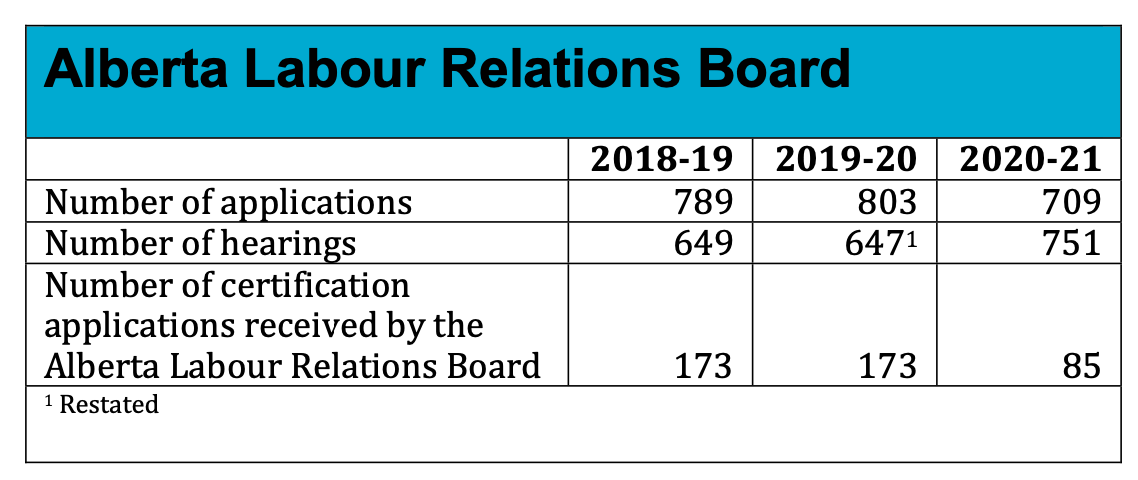
The number of certification applications in 2020/21 was way down (51%). This is likely the result of the reintroduction of mandatory votes (which makes certification drives riskier for unions) and COVID. On the upside, the Labor Board finally began allowing electronic filing (dumping their outdated paper/fax-only system).
-- Bob Barnetson
Tuesday, June 22, 2021
Alberta's 2019 injury data released
Alberta finally released its annual report on injuries and fatalities for 2019. Some of the key findings are that, from 2017 to 2019:

Manufacturing, processing and packaging was another sector with relatively high injury rates. We should expect this number to spike in 2020 and 2021 given the COVID waves that swept through the meat-packing plants. We’ll likely also see something similar in the public sector (particularly education and health care). We may also see this in mining, given the oilsands camp outbreaks.
There has been a long-term increase in occupational fatality rates in Alberta.

This has included a long-term reduction in the proportion of fatalities caused by motor vehicles accidents (blue bar in chart below) and an increase in workplace incidents (orange bar).

Claims related to harassment and violence doubled from 2015 to 2019. This may reflect, in part, greater awareness and acceptance of these sorts of injuries as a result of changes to the OHS Act and Code made by the New Democrats.

One of the most compelling charts is buried at the end of the document and it tracks injury rates over 10 years. Combined with the fatality rates chart above, the biggest take-away is that not much has changed.

This suggests that the injury-prevention strategies mandated by successive Alberta governments (which have emphasized education and voluntary compliance coupled with anemic enforcement) have not really moved the needle on worker injuries or workplace safety.

-- Bob Barnetson
- Lost-time claim numbers and rates are up slightly,
- Modified work numbers and rates are down some, and
- Overall, the number of disabling injuries is up slightly (likely population growth related) while the rate is down slightly.

Manufacturing, processing and packaging was another sector with relatively high injury rates. We should expect this number to spike in 2020 and 2021 given the COVID waves that swept through the meat-packing plants. We’ll likely also see something similar in the public sector (particularly education and health care). We may also see this in mining, given the oilsands camp outbreaks.
There has been a long-term increase in occupational fatality rates in Alberta.

This has included a long-term reduction in the proportion of fatalities caused by motor vehicles accidents (blue bar in chart below) and an increase in workplace incidents (orange bar).

Claims related to harassment and violence doubled from 2015 to 2019. This may reflect, in part, greater awareness and acceptance of these sorts of injuries as a result of changes to the OHS Act and Code made by the New Democrats.

One of the most compelling charts is buried at the end of the document and it tracks injury rates over 10 years. Combined with the fatality rates chart above, the biggest take-away is that not much has changed.

This suggests that the injury-prevention strategies mandated by successive Alberta governments (which have emphasized education and voluntary compliance coupled with anemic enforcement) have not really moved the needle on worker injuries or workplace safety.

-- Bob Barnetson
Tuesday, June 8, 2021
New data on injury under-reporting, claims suppression, and risk in small workplaces
Some new research updates have been published by the Institute for Work and Health. A study in BC looked at injury claiming behaviour. It found that approximately half of workers who have a work-related injury or illness that requires time away from work do not report the injury to the BC workers’ compensation system. Key explanations include workers not knowing they are entitled or how to apply or not thinking it is worth their time to do so. Further, between 4 and 13% of people with work-related injuries experience inducements or pressure from their employer not to report the injury.
You can read the full report here and a shorter policy briefing here. This table (nicked from the policy briefing) summarizes the recent evidence on underclaiming and suppression in workers' compensation claims.

The key take-aways are that there is pretty consistent evidence that only half of injured workers report injuries to the workers compensation system. That is to say, workers’ compensation data (which is basically what we use in Canada to assess injury rates and drive public policy) consistently and significantly under-estimates the true level of injury. Further, one of the factors that drives under-reporting by workers is employer claims suppression behaviour.
Interestingly, claim suppression is not the most common cause of under-reporting in the BC study. Workers not knowing to or how to report was a significant factor. This is followed by workers not thinking it was worth their while to do so (in part because some employers offer alternative forms of injury compensation).
A second study investigated the reasons underlying higher risk of injury to workers at small firms. The upshot of this study was that inadequate safety policies and procedures at smaller firms were the major source of higher injury rates. When this variable was controlled for, differences disappeared. This suggests that smaller workplaces are not intrinsically less safe and the greater risk of injury can be attenuated by improved organizational processes
-- Bob Barnetson
You can read the full report here and a shorter policy briefing here. This table (nicked from the policy briefing) summarizes the recent evidence on underclaiming and suppression in workers' compensation claims.

The key take-aways are that there is pretty consistent evidence that only half of injured workers report injuries to the workers compensation system. That is to say, workers’ compensation data (which is basically what we use in Canada to assess injury rates and drive public policy) consistently and significantly under-estimates the true level of injury. Further, one of the factors that drives under-reporting by workers is employer claims suppression behaviour.
Interestingly, claim suppression is not the most common cause of under-reporting in the BC study. Workers not knowing to or how to report was a significant factor. This is followed by workers not thinking it was worth their while to do so (in part because some employers offer alternative forms of injury compensation).
A second study investigated the reasons underlying higher risk of injury to workers at small firms. The upshot of this study was that inadequate safety policies and procedures at smaller firms were the major source of higher injury rates. When this variable was controlled for, differences disappeared. This suggests that smaller workplaces are not intrinsically less safe and the greater risk of injury can be attenuated by improved organizational processes
-- Bob Barnetson
Wednesday, May 26, 2021
Boss makes a dollar, we make a dime...
 |
| Everyone's friend, Bonhomme (not a boss). |
One of the challenges of organizing workers to resist an aggressive employer is the tendency of workers to disbelieve (at least, at first) that their employer could actually mean to treat them so badly.
This initial denial often reflects underlying anxiety (because the boss is powerful) and manifests itself in several ways. For example, workers may:
My most recently previous boss's house is up on the market and, through the miracle of virtual tours, we can see how the 1% really lives. The address in the posting isn’t exactly correct, based on my pre-picket scouting during our last round of bargaining. I’m not sure how long this posting will be live (the virtual tour is something) so I screen capped a few of the photos.

I’ve been to a lot of members' homes—usually for good reasons, sometimes for sad ones. None of them have come close to this size (3800 sq ft on 3/4 of an acre backing onto a pond) or level of luxury.

The main floor boosts a huge living room (with piano), dining room, kitchen, and master suite. The quality of the finishes put my house (which is pretty nice) to shame.

The master suite includes a soaker tub with its own fireplace, which is important when you need to relax after the difficult days of grinding workers’ wages.

And satin sheets will help you sleep away your guilt at pretending to care about keeping jobs in the Athabasca region, while actually moving them away.

The upstairs has an enormous bedroom (not shown), while the basement features a wet bar area that connects a massive family room with a rec room. What better place to gather your minions and hatch plans to bust your workers’ union!

The point here is that bosses superficially look like workers. But they don’t share our circumstances or our interests. And revealing that difference to workers—in material terms—can go a long way towards undercutting the boss’s messaging.
-- Bob Barnetson
- question whether the union is mis-informed about what is happening or mis-understands it,
- suggest the employer has made an innocent error and can be talked around or shown the error of their ways, or
- try to make excuses for the employer (“they have no choice”).
Workers can eventually move past these initial responses, especially when the employer repeatedly misbehaves (which eventually creates a “the boss who cried wolf” dynamic). A sly employer can draw out the period of denial with a good “bonhomie” routine or by creative gaslighting.
One strategy unions can use to get past this is to help workers understand that bosses really aren’t like them. Sure, they wear a skin suit and have kids and like to wakeboard and go on Disney cruises. But their world is fundamentally different.
But how to show this? Well, money talks. So a peak inside the boss's house is a great way to illustrate—in an immediate and material way—that the boss isn’t worried about where their next paycheque comes from. And, when the boss takes a wage freeze or tiny rollback, it doesn't have the same effect as when they try to push that on workers.
One strategy unions can use to get past this is to help workers understand that bosses really aren’t like them. Sure, they wear a skin suit and have kids and like to wakeboard and go on Disney cruises. But their world is fundamentally different.
But how to show this? Well, money talks. So a peak inside the boss's house is a great way to illustrate—in an immediate and material way—that the boss isn’t worried about where their next paycheque comes from. And, when the boss takes a wage freeze or tiny rollback, it doesn't have the same effect as when they try to push that on workers.
My most recently previous boss's house is up on the market and, through the miracle of virtual tours, we can see how the 1% really lives. The address in the posting isn’t exactly correct, based on my pre-picket scouting during our last round of bargaining. I’m not sure how long this posting will be live (the virtual tour is something) so I screen capped a few of the photos.

I’ve been to a lot of members' homes—usually for good reasons, sometimes for sad ones. None of them have come close to this size (3800 sq ft on 3/4 of an acre backing onto a pond) or level of luxury.

The main floor boosts a huge living room (with piano), dining room, kitchen, and master suite. The quality of the finishes put my house (which is pretty nice) to shame.

The master suite includes a soaker tub with its own fireplace, which is important when you need to relax after the difficult days of grinding workers’ wages.

And satin sheets will help you sleep away your guilt at pretending to care about keeping jobs in the Athabasca region, while actually moving them away.

The upstairs has an enormous bedroom (not shown), while the basement features a wet bar area that connects a massive family room with a rec room. What better place to gather your minions and hatch plans to bust your workers’ union!

The point here is that bosses superficially look like workers. But they don’t share our circumstances or our interests. And revealing that difference to workers—in material terms—can go a long way towards undercutting the boss’s messaging.
-- Bob Barnetson
Thursday, May 20, 2021
No evidence paid sick leaves kills jobs
Canada and the US are outliers in historically having no statutory paid sick leave. Alberta’s opposition party has proposed 10 days of leave as a pandemic response measure. This logic of this proposal is basically that paid sick leave would help some sick workers decide to stay home by providing security of employment, income, and benefits. Yesterday, Alberta’s premier called paid sick leave a “job killing” proposal.
A 2010 report by the World Health Organization (in the wake of H1N1) suggests that paid sick leave has benefits that far outweigh its costs in Europe. The benefits include:
The WHO report suggests European costs are relatively low (averaging just under 200 Euros per year per capita), and paid sick leave is associated with greater productivity.
A US study examined the effect of sick leave mandates in several US cities and states on the number of private sector jobs. These proposals see workers accrue sick leave over time (kind of like; vacation entitlements). The upshot is that there appears to be effectively no impact on jobs numbers (i.e., sick is not a job-killing policy).
A separate study focused on New York’s employer paid sick leave mandate (which extended sick leave to millions of employees) also suggests paid sick leave is no big deal.
Not providing sick leave, by contrast, is likely to increase in the spread of COVID (as workers come to work sick for fear of losing their jobs or not being able to pay their bills). In this way, Premier Kenney’s unwillingness to consider paid sick leave is a “worker killing” policy.
-- Bob Barnetson
A 2010 report by the World Health Organization (in the wake of H1N1) suggests that paid sick leave has benefits that far outweigh its costs in Europe. The benefits include:
- Access promptly medical care and the opportunity to follow treatment recommendations
- Recuperate more quickly
- Reduce the health impact on day-to-day functioning
- Prevent more series illnesses from developing
- Reduce the spreading of diseases to the workplace and community (p.6).
The WHO report suggests European costs are relatively low (averaging just under 200 Euros per year per capita), and paid sick leave is associated with greater productivity.
A US study examined the effect of sick leave mandates in several US cities and states on the number of private sector jobs. These proposals see workers accrue sick leave over time (kind of like; vacation entitlements). The upshot is that there appears to be effectively no impact on jobs numbers (i.e., sick is not a job-killing policy).
A separate study focused on New York’s employer paid sick leave mandate (which extended sick leave to millions of employees) also suggests paid sick leave is no big deal.
- Most employers experienced no cost increases and those who did (14%), the majority reports <3% change.
- More than 91% of employers reported no reduction in hiring
- 97% of employers indicated that they did not reduce hours
- 98% of employers reported virtually no abuse of sick leave and percentage of no-abuse reported was higher for small businesses.
- 96% reported either no decline or an increase in productivity.
Not providing sick leave, by contrast, is likely to increase in the spread of COVID (as workers come to work sick for fear of losing their jobs or not being able to pay their bills). In this way, Premier Kenney’s unwillingness to consider paid sick leave is a “worker killing” policy.
-- Bob Barnetson
Friday, April 30, 2021
Presentation: Science fiction and organized labour
An interesting presentation by Olav Rokne about the the presence and absence of unions in science fiction.
Subscribe to:
Posts (Atom)